


Nordic winters are unlike any other, with mountains of fresh snow crunching under your feet and the Aurora Borealis lighting up the night sky. And what better way to experience them than with a cosy stay in an igloo, covered in a warm blanket and a heated sleeping bag? Here are our picks for the coolest snow winter hotels in Europe.
Icehotel – Jukkasjärvi, Sweden
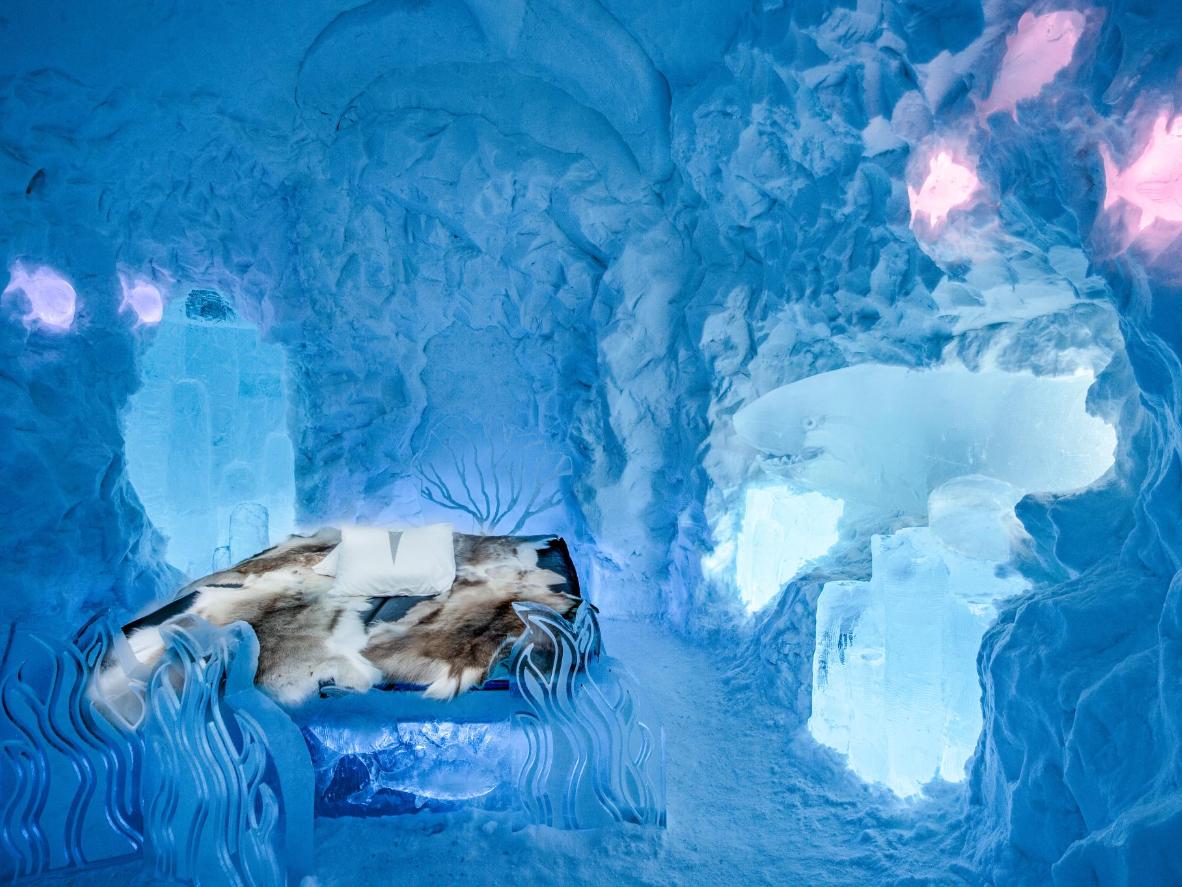
Icehotel
The rooms at Jukkasjärvi's Icehotel are entirely constructed of ice sculpted from the nearby Torne river and contain exquisite frozen sculptures by foreign artists. There's also an à-la-carte restaurant and a lounge with board games, perfect for a relaxing evening. For those who want to explore more of the Swedish countryside, Luossavaara mountain and ski resort are only 20 kilometres away.
Sinettä, Finland: Arctic Snow Hotel & Glass Igloos

Arctic Snow Hotel
The Arctic Snow Hotel is a secluded resort in rural Finnish Lapland with suites made completely of snow and ice. Visitors can unwind in the outdoor hot tub or snow sauna and ask for a wake-up call to witness the breathtaking Aurora Borealis. For those who want to exchange vows in a really unique setting, there is even an on-site ice chapel and bridal suite. Or, if you'd like, you can spend the night in a glass igloo under the stars. These contemporary igloos have insulated glass roofs that provide unobstructed views, so you may admire the Northern Lights from the comfort of your bed. You can try native pursuits like ice fishing, snowshoeing, and eating at the ice café for a truly realistic Arctic Circle experience.

A positive attitude toward life and aging may assist you in living longer.
Do you anticipate the coming week? Do you think you're younger than you are? Do you feel like you're on a mission? If this is the case, you may have already taken steps to lower your risk of degenerative diseases and may even be extending your life.
Dr. Laura Kubzansky, professor of social and behavioural sciences at Harvard T.H. Chan School of Public Health, says, "Your outlook—having a feeling of optimism and purpose—seems to be predictive of health outcomes." Dr. Kubzansky has researched the implications of many types of psychological well-being on one's health. She discovered that emotional vitality, which she defines as "enthusiasm, hopefulness, participation in the life, and the ability to deal with life's pressures with emotional balance," is linked to a lower risk of heart attack and stroke.
Emotional vitality's advantages
Dr. Kubzansky and her colleagues looked at data from the Nationwide Health and Nutrition Examination Study (NHANES), which is a long-term national study that includes both personal interviews and medical exams.
Her team revealed in 2007 that people with high levels of emotional vitality at the start of the study had a much lower incidence of cardiovascular disease 15 years later. They reported in 2015 that more emotional liveliness was linked to a decreased risk of stroke among 6,019 patients studied for an average of 16 years.
Other research has found that those who maintain emotional vibrancy while suffering from chronic disease or disability fare better. The Women's Health and Aging Study includes more than 1,000 women aged 65 and up who are disabled but still live independently. On two tests meant to measure the loss of function—walking speed and the ability to lift at least 10 pounds—women with greater emotional vitality fared much better than their less optimistic peers, who had identical levels of handicap.

Here's how to respond and what to do if you think they're right.

You've spent the majority of your life worrying about your children's health and safety, so having the roles reversed can feel strange and unfamiliar. That could be the case if your adult children express concerns about your ability to walk, drive, or remember details.
Abby Altman, a geriatric psychologist at Harvard-affiliated Brigham and Women's Hospital, and Dr. Suzanne Salamon, associate chief of gerontology at Harvard-affiliated Beth Israel Deaconess Medical Center, offer advice and insight.
What should you keep in mind?
"These discussions are frequently motivated by concern and love. "Your children want you to live as long as possible in this world," Altman claims. Furthermore, your health and treatment have an impact on the entire family unit. Finally, you are the one who makes the decisions that affect your health. However, your children may have different ideas about how to keep you healthy. It is worthwhile to consider their suggestions. "
What if it appears to be intrusive?